I never agreed to become somebody's political mascot
Everybody wants to tell everybody else what they're supposed to believe. Who you have to support. Who you have to condemn. What your silence supposedly says about you. And if you're Black? Apparently, some people believe they already know which political feelings you're obligated to have.
I am tired of people attempting to make other people feel guilty for declining to participate in their political performance. You want to vote? Make your choice. You want to organize? Organize. You want to argue for a policy? Bring the argument. But why does my refusal to perform agreement become an invitation to interrogate my character?
I can recognize that elections have consequences without accepting that another person gets to prescribe my emotional reaction to a politician. I can care about people without handing strangers the authority to decide what caring must look like.
And I can think for myself without auditioning to prove that I'm one of the 'good' ones.
How much of the outrage is about being seen?
Some conversations feel less like an attempt to understand the world and more like a competition to be publicly identified as the person who understands it best. Who has the approved opinion? Who delivers the sharpest condemnation? Who gets to stand above the room and announce that everyone else is ignorant?
That performance raises a question worth asking, not a verdict about everyone's motives: are we trying to understand something, or are we trying to be seen understanding it?
People will swear they know what some public figure is 'really' like, as though a screen gives them intimate access to the entirety of another human being. Meanwhile, the people they actually know, the relationships they actually participate in, and the harm they can actually address may receive a fraction of that examination.
It gets stranger when someone extends endless context to a friend but none to a stranger. A friend gets history, circumstances, growth, and the benefit of the doubt. A stranger gets one clip, one old sentence, one opinion, and a permanent label.
I am not arguing that actions should be excused. Harm is real. Accountability matters. But reducing a whole person to a classification is an incredibly narrow way of thinking.
There is no true evil, only misguidance
That's a philosophical position I hold. It does not erase damage or tell harmed people to forgive anyone. It asks us to look for mechanisms, consequences, conditions, and the possibility of change before pretending a label explains an entire existence.
What happened? Who was affected? What can be repaired? What conditions made the behavior possible? What prevents it from happening again?
Those questions can create accountability with an actual destination. Endless condemnation can become its own destination.
And if we are capable of building games, competitions, arguments, and institutions with extraordinary intensity, why must cruelty be treated as a necessary feature of the experience? Conflict can have rules. Competition can preserve dignity. Disagreement can produce understanding without demanding dehumanization.
Who gave you the frame?
Nobody asked us which economic arrangements, institutions, inherited disputes, social hierarchies, or political categories we wanted to be born into. We arrived in an already-running world and learned its language before we had a meaningful opportunity to question its assumptions.
Then, as adults, we're told to choose between the options already presented and treat those options as the full extent of reality. Even our rebellion can become a standardized performance within the same picture.
But there is an entire difference between having choices and recognizing the range of choices available. The issue sometimes begins upstream of the decision: with the frame through which the possibilities are seen.
That's why I keep returning to Perspective Expansion. Before asking which side of a dispute deserves your attention, ask who defined the dispute. What is excluded from the conversation? What could you build if your attention were no longer occupied by proving that you belong to the correct camp?
The Trillionaire's attention belongs to the Trillionaire
Trillionaires don't get sideswept by every urge to react. We can observe a conflict without being recruited into it. We can understand another person's reality without making it the center of our own.
This isn't a promise that simply thinking differently changes everything happening outside us. It is recognition that what we perceive, how we interpret it, and what we decide to do next are part of the trajectory we can influence.
Attention is finite. An hour invested in a ritual of outrage is an hour that cannot simultaneously go toward creating, learning, caring for somebody nearby, solving a problem, resting, or expanding the number of futures you can actually pursue.
That doesn't make civic participation worthless. It means participation should be conscious, not demanded as proof of moral membership. Nobody should have to outsource their entire identity to an argument.
Vote for your fucking self. Vote to go within. Examine the assumptions underneath your reactions, including the reactions you feel most certain about. The point is to develop judgment, not merely to inherit a position.
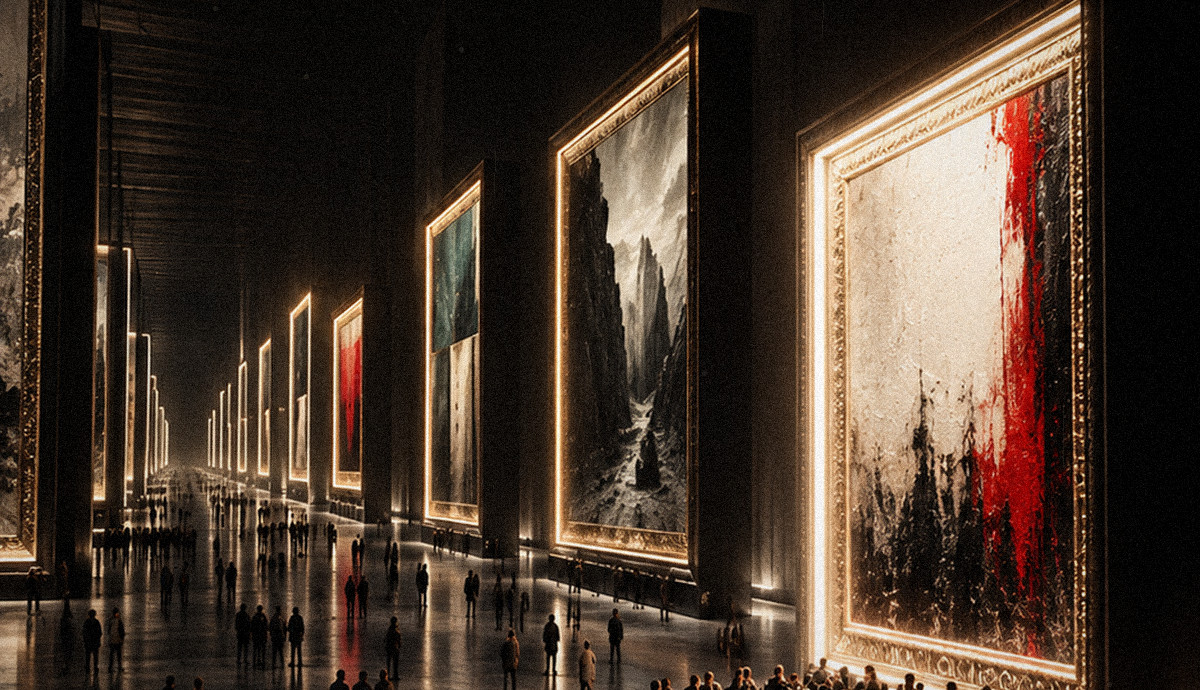
The gallery
Humans are fascinating. We can build vast systems, recognize patterns, invent new institutions, and imagine lives that have never existed. And still, we can become so invested in a single argument that we forget to look around.
People need to think outside the motherfucking frame they were positioned to see out of.
There's a whole fucking art gallery out here.
And some of y'all are spending your entire lives arguing over one painting.